

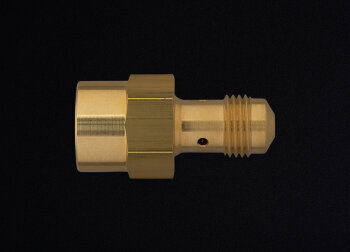
Precision milling is a necessary result of advanced manufacturing technology and exacting engineering requirements. Delivering components that meet stringent dimensional tolerances, complex geometries, and surface finish demands requires more than traditional machining - it requires precision CNC milling.
What Is Precision Milling?
Precision milling is a form of CNC machining where rotary cutting tools remove material from a fixed workpiece under exact digital control. This process relies on advanced CAD/CAM programming to guide the machine along defined toolpaths, enabling the creation of intricate shapes, features, and tight tolerances that manual machining cannot reliably achieve.
Unlike basic machining, precision CNC milling integrates sophisticated automation to ensure repeatability and accuracy. Modern machines can operate with tolerances measured in thousandths or ten-thousandths of an inch, which is critical for industries such as aerospace, medical, automotive, and electronics.
How Precision Milling Works
The precision milling process generally follows this workflow:
- Digital Design: Engineers create a CAD model that defines geometry, critical dimensions, and tolerance requirements.
- CAM Programming: CAM software converts the CAD model into machine instructions (G-code) that guide tool movement, speeds, feeds, and machining strategies.
- Machine Setup: The workpiece is fixtured and tooling is loaded. Automatic systems, such as tool changers and touch probes, help ensure setup accuracy and speed.
- Execution: The CNC milling machine executes the program, precisely controlling tool paths to remove material while maintaining positional accuracy across multiple axes.
- Inspection and Finishing: Final inspection and surface finishing processes ensure the part meets all specifications.
This digitally driven method enables unmatched precision, consistency, and efficiency compared to manual machining.
Precision Milling at Micro Precision Components
At MPC, precision milling is a core service offering within our comprehensive suite of CNC machining capabilities. We produce high-precision, custom-machined parts tailored to the exact specifications of each customer project.
Key aspects of MPC’s precision milling include:
- Geometric Versatility: Milling tools move around the workpiece to create complex shapes - especially parts that are not axially symmetrical - expanding the range of possible geometries beyond what turning alone can achieve.
- Machine Quality and Surface Finishing: We utilize machines such as Tornos and Haas, supporting consistent precision. We also provide options for high surface finishing, including mirror-like finishes when required.
- Material Range: Precision milling at MPC supports various materials, from stainless and carbon steels to aluminum, brass, plastics, and exotic metals like titanium and beryllium copper.
Why Precision Milling Matters
Precision milling delivers multiple strategic benefits for modern manufacturing:
- Tight Tolerances: CNC milling achieves tolerances far beyond manual methods, critical for parts that must fit precisely within larger assemblies or perform under high-stress conditions.
- Consistency Across Production Runs: The automation inherent in CNC processes ensures that parts produced in mid- to high-volume runs maintain uniform quality and adherence to specifications.
- Material Versatility: Milling supports a wide range of materials, enabling engineers to select the material that best meets performance goals - whether for strength, weight reduction, or environmental resistance.
- Complex Geometry: Multi-axis CNC milling machines can produce features such as pockets, undercuts, and multi-plane contours that would otherwise require multiple setups or additional post-processing.
Applications Across Industries
Precision milling is essential across sectors where part accuracy is non-negotiable:
- Aerospace: Structural components and assemblies demand dimensional exactness and repeatability.
- Medical Devices: Implants and surgical instruments require precise geometries and flawless finishes.
- Automotive: Engine and transmission components benefit from consistent, tight tolerances.
- Electronics: Housings and connectors often feature delicate features that must be machined with precision.
Precision milling transforms digital designs into physical components with exceptional dimensional control, surface quality, and repeatability. By combining advanced CNC equipment with CAD/CAM programming and robust process controls, we can deliver parts that meet exacting customer requirements and industry standards. Whether producing prototypes or precision production runs, precision milling is a foundational capability for any organization focused on high-performance manufacturing.