

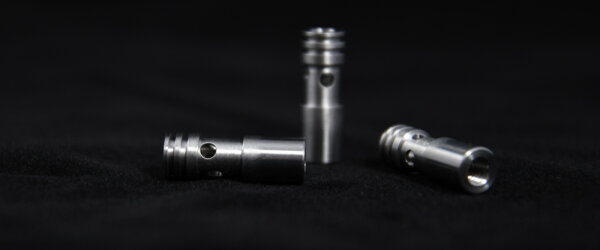
Known for its ability to produce complex, tight-tolerance components at scale, Swiss CNC machining is often a preferred machining option for industries that require consistency, speed, and cost control.
What Is Swiss Machining?
Swiss machining, also known as Swiss CNC machining or Swiss screw machining, is a specialized machining process that uses a sliding headstock and guide bushing to support the component close to the cutting tool.
This setup reduces deflection and vibration, allowing for:
- Ultra-precise cuts
- Consistent tolerances
- Efficient machining of long, slender, and complex parts
Swiss machines are particularly effective for small and micro, intricate components that require high repeatability.
Why Swiss Machining Is Ideal for High-Volume Part Production
1. High Precision and Tight Tolerances
One of the primary advantages of Swiss machining is its ability to maintain extremely tight tolerances, often within a few microns.
For high-volume part production, this means:
- Consistent part quality across thousands of units
- Reduced scrap and rework
- Improved product reliability
Swiss CNC machining ensures that every part meets exact specifications, even in long production runs.
2. Faster Part Production Through Simultaneous Machining Operations
Modern Swiss machines are equipped with multiple tool stations and live tooling, allowing for simultaneous machining operations for a part. This results in:
- Shorter cycle times
- Increased throughput
- Continuous, unattended (lights-out) production
For businesses producing large quantities of micro parts, Swiss machining significantly improves overall manufacturing efficiency.
3. Reduced Secondary Operations
Swiss machining enables complete part machining in a single setup, including turning, drilling, milling, threading, and slotting. Benefits include:
- Lower labor costs
- Fewer machine transfers
- Reduced risk of dimensional errors
By minimizing secondary operations, Swiss machining streamlines production and accelerates delivery timelines.
4. Cost-Effective for Large Production Runs
While setup costs for Swiss CNC machining can be higher than traditional methods, the per-part cost decreases significantly at scale. Cost advantages:
- Lower labor requirements
- Reduced material waste
- Minimal scrap rates
- Faster production cycles
For high-volume micro part machining jobs, Swiss machining delivers strong ROI and predictable cost control.
5. Superior Surface Finish and Quality
Swiss machines provide excellent part surface finishes due to their stability and precision. This leads to:
- Reduced need for post-processing
- Improved functionality in precision applications
- Enhanced appearance for consumer-facing parts
High-quality finishes are especially important in industries like medical and electronics.
6. Swiss Machining is Best for Small and Micro, Complex Precision Parts
Swiss machining is optimized for small-diameter, high-precision components, making it ideal for:
- Medical devices (pins, implants, surgical tools)
- Aerospace components
- Automotive parts (fuel system components, sensors)
- Electronics (connectors, contacts)
If your parts require intricate geometries, Swiss CNC machining is often the most efficient solution.
7. Consistency and Repeatability at Scale
Swiss machining maintains uniformity across long production runs. This ensures:
- Reliable part-to-part consistency
- Easier quality assurance processes
- Compliance with strict industry standards
For high-volume part manufacturing, consistency is just as important as speed, and Swiss machining offers both.
When to Use Swiss Machining
Swiss machining is the best choice when your project requires:
- High-volume part production
- Tight tolerances and precision machining in small and micro parts
- Complex geometries in small and micro parts
- Reduced secondary operations
- Cost efficiency over long runs
If these are requirements for your part, Swiss CNC machining can dramatically improve production performance.
Why Swiss Machining Is a Competitive Advantage
Swiss machining offers a powerful combination of precision, efficiency, and scalability, making it one of the most effective solutions for high-volume manufacturing. By leveraging Swiss CNC machining, manufacturers can:
- Increase output
- Reduce costs
- Maintain strict quality standards
- Deliver complex parts with speed and accuracy
For companies focused on producing high volumes of precision components, Swiss machining is ideal.